

Last updated: November 4, 2026
Quick answer: A slim-framed square mirror with a simple, timeless look. It suits entryways, bedrooms and living rooms, and works well as part of a gallery wall.
Some links below are affiliate links. If you buy through them I may earn a small commission at no extra cost to you. I have not tested these mirrors myself. The notes below are based on each retailer’s listing and description.
Choosing a wall mirror is mostly a question of size, shape, frame and budget. This post compares five mirrors from Pottery Barn, West Elm, Amazon, IKEA and Dunelm so you can see what each is good for and where it falls short. For a broader guide to styles, see modern mirror styles and decorative mirrors for the living room.
Key takeaways
- Small square mirrors (Pottery Barn) work best layered on a gallery wall or in an entryway.
- Irregular shapes (West Elm, Autdot) act as wall art, so use only one per wall.
- A slim gold frame (IKEA) is the easiest budget way to add warmth.
- Ornate, wide frames (Dunelm) are heavy and need strong wall fixings.
Quick comparison
| Mirror | Style | Best for | Watch out for |
|---|---|---|---|
| Pottery Barn Stowe small square | Clean, classic | Gallery walls, entryways | Too small for big walls |
| West Elm asymmetrical mixed forms | Artistic, modern | Accent walls | Higher price, needs careful hanging |
| Autdot irregular wall mirror | Playful, modern | Living rooms, bedrooms | Frame may feel light |
| IKEA LINDBYN gold | Minimal, warm | Hallways, bedrooms | Finish may wear in damp rooms |
| Dunelm Vivian | Vintage glam | Living rooms, hallways | Heavy, can crowd small rooms |
The five mirrors
Pottery Barn Stowe Small Square Mirror

A slim-framed square mirror with a simple, timeless look. It suits entryways, bedrooms and living rooms, and works well as part of a gallery wall.
Pros
- Clean design that fits many styles
- Good size for layering in a gallery wall or entryway
- Retailer lists hanging hardware as included
Cons
- Limited frame colours
- Too small to be a statement piece on a large wall
Listed price when this post was first written: $69. Prices change, so check the retailer for today’s price. View it at the retailer.
West Elm Asymmetrical Mixed Forms Wall Mirror

A mirror that mixes curves and angles, so it reads as wall art as much as a mirror. Best used as the only bold shape on a wall.
Pros
- Distinctive shape works as an accent piece
- Suits modern interiors
- Reflects light and adds depth
Cons
- Priced above standard mirrors
- Irregular shape may not suit traditional rooms
- Needs careful positioning so it hangs balanced
Listed price when this post was first written: £399.00. Prices change, so check the retailer for today’s price. View it at the retailer.
Autdot Decorative Irregular Wall Mirror

A lower-cost irregular mirror for people who like the organic-shape trend without a designer price. It suits living rooms, bedrooms and entryways.
Pros
- Fun, modern shape
- Described as lightweight
- Cheaper than designer irregular mirrors
Cons
- Frame may feel less sturdy than higher-end mirrors
- Check the size carefully, as it may be smaller than expected
- Finish can vary between batches
Listed price when this post was first written: $162.98. Prices change, so check the retailer for today’s price. View it at the retailer.
IKEA LINDBYN Mirror in Gold

A simple mirror with a slim gold frame. It works vertically or horizontally and is one of the easiest budget ways to add warmth to a hallway or bedroom.
Pros
- Affordable for the look
- Gold frame adds warmth
- Simple shape fits modern or classic rooms
Cons
- Glass can scratch if cleaned roughly
- Frame finish may wear in damp rooms such as bathrooms
Listed price when this post was first written: $79.99. Prices change, so check the retailer for today’s price. View it at the retailer.
Dunelm Vivian Wall Mirror
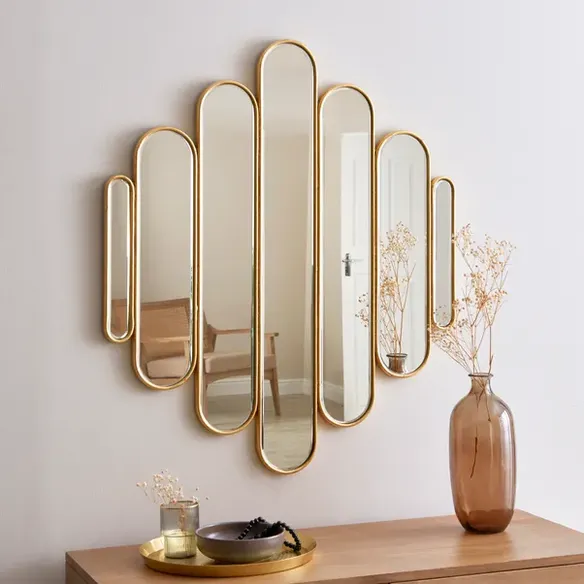
A wide, detailed frame for a vintage-glam look. It suits living rooms, bedrooms and hallways with enough space to carry it.
Pros
- Detailed frame adds character
- Solid, substantial feel
- Works in several rooms
Cons
- Heavier than average, so it needs strong wall fixings
- May overwhelm a small room
- Mainly sold in the UK
Listed price when this post was first written: £90. Prices change, so check the retailer for today’s price. View it at the retailer.
How to choose a wall mirror
- Size: over furniture, aim for about two-thirds of its width. A small mirror on a big wall looks lost.
- Height: centre it around eye level, roughly 57 to 65 inches from the floor. Our hanging height calculator helps.
- Frame: thin frames feel modern, wide or ornate frames feel traditional.
- Weight: check it before you buy, and use studs or rated anchors for heavy mirrors.
- Room: avoid unsealed wood or delicate finishes in damp bathrooms. See farmhouse bathroom mirrors for bathroom picks.
How do you choose the right mirror size and position?
| Question | Guide |
|---|---|
| How wide? | About two-thirds of the width of the furniture beneath it |
| How high? | Centre near eye level, 57 to 60 inches from the floor according to UGallery |
| How far above furniture? | At least 6 to 12 inches for large framed pieces, per UGallery |
| Where? | Opposite or beside a window to reflect daylight |
| What to avoid? | Facing clutter or a harsh light source |
Tape a paper template to the wall first. It costs nothing and shows you how the size will look before you buy or drill.
What mistakes should you avoid when choosing a mirror?
- Choosing a mirror that is too small for the wall.
- Hanging it too high, so it reflects the ceiling.
- Forgetting the weight and using weak fixings.
- Placing it where it reflects clutter.
- Buying for the frame alone and ignoring where you will hang it.
Start with the wall, then choose the mirror. That order avoids most mistakes.
How do you hang a mirror safely?
- Check the maker weight and the hanging hardware supplied.
- Find studs or a solid wall and use anchors rated above the weight.
- Mark the centre height and measure the hanging point on the back.
- Use a level and have a second person help.
- Check the height from where you will stand before you step away.
Which mirror suits which room?
- Living room: a large round or statement mirror above a sofa or sideboard.
- Hallway: a mirror above a console, which also helps you check your look as you leave.
- Bedroom: a tall mirror leaned or fixed where you dress, placed away from the bed for a calmer feel.
- Bathroom: a moisture-rated mirror sized to the vanity and lit on both sides.
- Dining room: a mirror opposite a window or lamp to bounce light across the table.
Check each mirror for weight and for the hanging hardware supplied. In a bathroom, choose a mirror and fixings suited to damp conditions.
The same two checks apply everywhere: measure the wall and furniture first, and test the position with paper before you drill. This avoids the most common mistakes, such as a mirror that is too small or hung too high.
How Do You Compare Mirror Brands Beyond the Price Tag?
Look at the construction details rather than the label. Check the frame material, the glass quality, the thickness, the backing and the hanging hardware. Higher-priced mirrors often have sturdier frames and better finishing, but a mid-priced mirror may offer similar quality in a simpler design. Read product descriptions carefully and compare specifications side by side.
Check the size and shape options. Some brands offer a wide range of sizes and finishes, while others focus on a few styles. Choose the brand that has a mirror in the size and frame you need rather than compromising on dimensions.
Consider delivery and returns. Large mirrors are fragile and heavy, so check delivery times, packaging, damage policies and return conditions before ordering.
How Do You Decide Between a Premium and a Budget Mirror?
Think about how long you plan to keep it and where it will hang. A mirror in a high-visibility spot such as a living room or hallway may justify spending more, while a mirror in a guest room or a rental might not. Consider whether the frame finish will be handled often or exposed to humidity, since quality finishes last longer.
Compare the warranty and customer support. A longer guarantee and responsive support add value, especially for large items. Check reviews that include photographs and comments about the colour and condition on arrival.
How Do You Hang and Style the Mirror You Choose?
Use proper wall anchors for the weight and check the hanging hardware. Hang the mirror at a height that suits the room, with the centre near eye level, and use a spirit level. Style the area around it with a lamp, a plant or a console table, so the mirror becomes part of a composition.
Keep the glass clean and check the fixings once a year. If you have children or pets, secure large leaning mirrors to the wall.
What Should You Check Before Buying Online?
Confirm the exact dimensions, the weight, the frame material and the packaging. Check the return policy and look for customer photos. If a mirror is critical to your design, order a sample of the finish where available or visit a showroom before deciding.
Which Mirror Is Best for 2027?
The best mirror is the one that suits your room, your budget and your style. Rather than following one brand or trend, choose quality materials, a safe fixing and a size in proportion to your space.
How Do Wall Mirrors Compare for Different Rooms and Uses?
A mirror for a hallway needs to be tall enough to check an outfit, whereas a bathroom mirror should be moisture-resistant and easy to clean. In a living room, a decorative frame matters more because the mirror is part of the style of the room. Match the mirror to the room’s purpose and think about reflection, light and safety as well as looks.
Consider the style of the frame, the size and the room’s other metals. Warm brass suits traditional rooms, black frames create contrast in modern spaces and natural wood warms Scandinavian interiors. Choose the finish that coordinates with taps, handles and lamp bases.
Look at weight and installation. A large, heavy mirror may need two people to hang and strong fixings. Check the hanging kit, and use anchors rated above the mirror’s weight.
What Do Customer Reviews Tell You About Mirrors?
Reviews reveal real-world issues such as colour differences, packaging damage and the quality of hanging hardware. Look for comments with photographs, check for repeated complaints and note how the seller responds. Treat extreme reviews, both positive and negative, with caution, and look at the overall pattern.
Compare reviews across more than one retailer where you can, and check whether the product description matches the photographs.
How Do You Maintain a Wall Mirror So It Lasts?
Clean with a soft cloth and glass cleaner, avoid spraying directly on the frame and dry edges. Keep the mirror away from constant dampness unless it is designed for it, and check the hanging hardware occasionally. Replace damaged fixings promptly.
If the silvering shows black spots or peeling, moisture may be reaching the back, and it may be time to replace the mirror.
How Do You Choose the Right Mirror Size for Your Wall?
Choose a width around two thirds of the furniture beneath, and hang it so that the centre sits near eye level. Test the size with a paper template and photograph the wall. If you are unsure, go slightly larger, since oversized mirrors often look more intentional than small ones.
How Do You Match a Mirror to Your Existing Decor?
Look at the metals, woods and colours already in the room and choose a frame that repeats one of them. If your lamps and cabinet handles are brushed brass, a brass or gold-toned frame ties the room together, while black frames echo window frames and industrial lighting. Natural wood suits rooms with timber floors or furniture, and white or pale frames blend into light walls for a softer look.
Pay attention to scale and shape. A mirror that is too small can look like an afterthought, whereas a generous piece creates a focal point. Echo shapes from nearby items, such as round tables or arched windows, to create harmony. If you are unsure, lean a mirror in place, or cut a paper template, and look at it for a few days before you buy.
Which Type of Wall Mirror Should You Buy First?
If you are buying your first statement mirror, choose a simple, well-proportioned frame in a neutral finish that will work in more than one room. A round or gently arched mirror in a natural wood or slim metal frame is easy to move later, and it will keep its look even if you change your furniture. Start with one good mirror and add others over time rather than buying a full set at once.
!– wp:heading –>
Quick recap checklist
Use this short checklist to confirm you have covered the main points of this guide to best wall mirrors before you start.
- The five mirrors
- Pottery Barn Stowe Small Square Mirror
- West Elm Asymmetrical Mixed Forms Wall Mirror
- Autdot Decorative Irregular Wall Mirror
- IKEA LINDBYN Mirror in Gold
- Dunelm Vivian Wall Mirror
- How to choose a wall mirror
Before you start: five questions to ask yourself
A few honest answers now will save time and money later. Write them down and keep them close while you shop or plan.
- What is the main purpose of this space or piece, and who will use it every day?
- What are the exact measurements, and have you marked them out with tape or paper before buying?
- Which colours and materials already exist in the room, and will your choice for best wall mirrors work with them rather than compete?
- What budget have you set, and which part deserves the most spending: the piece you touch every day or the accents?
- Could you live with this choice for at least a year, or would a smaller, easily changed version be wiser?
<
Frequently asked questions
Which wall mirror is best for a small room?
A slim-framed or frameless mirror keeps the look light. Place it opposite or beside a window to reflect daylight.
Are irregular mirrors still in style?
They remain popular as wall art. Use one on a wall and keep the surrounding decor simple.
How do I hang a heavy mirror?
Fix it into studs or use anchors rated well above its weight, and ask a qualified installer if you are unsure.
What is the best mirror for a living room?
For most living rooms, a large mirror with a slim frame hung above a sofa or console is the safest choice because it reflects light without competing with the decor. If you want a statement, pick one irregular or ornate mirror and keep everything else on the wall simple.
Is the IKEA LINDBYN mirror a good budget choice?
Going by the retailer listing, it is a slim gold-framed option at a low price, which suits renters and anyone who wants warmth without a heavy frame. We have not tested it, so check the size and frame finish in the listing before you buy.